The forest around the Tatra Educational Park, history of Tatra forests and the bark beetle
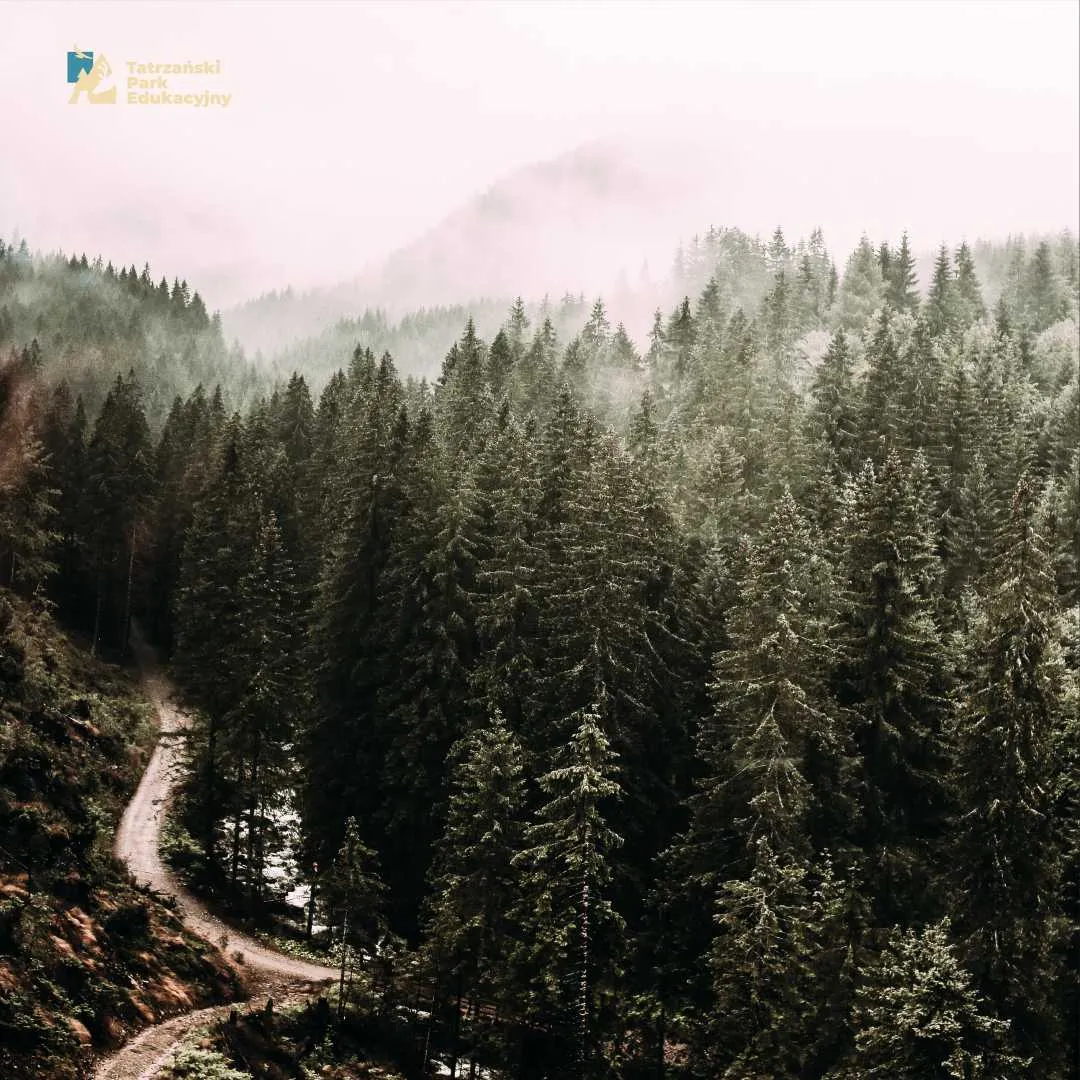
The forest around the Tatra Educational Park
Is the forest around the Tatra Educational Park and the one growing within the boundaries of Tatra National Park the same forest that grew here hundreds and thousands of years ago? Not quite.
Spruce, dominant in the Tatras
Walking through the Tatra valleys and visiting our Park, you may notice that spruce clearly dominates the forests. It is a coniferous tree with very sharp needles and cones hanging from its upper branches. Today it is the dominant species in the lower forest zone of the Tatras, but it has not always been so!
Spruce entered the Tatras 9000 years ago, after the glaciers had disappeared. For several thousand years it was the dominant species, reaching heights of up to 1700 meters above sea level. Soon, however, in the lower forest zone, it began to give way to beech and fir trees.
The primeval Carpathian forest
The Carpathian primeval forest, the original type of forest covering the entire Carpathians (except for the Tatra upper forest zone and higher parts), was a beech and fir forest where spruce was only an admixture.
What happened to so dramatically change this situation? Humans entered the picture.
Forest clearance for industry
In the 18th and 19th centuries, industry developed very dynamically in the Tatras, mainly mining and metallurgy. To supply forges, as well as for building mining tunnels and the entire infrastructure, the Tatra forests began to be intensively cleared, mainly the easily accessible lower forest zone.
Beech held particular importance in metallurgy due to its high calorific value. After the mining and metallurgical industries declined, the Tatra forests continued to be cut, this time for the sawmill and paper industries.
Additionally, intensive sheep grazing, not only in mountain pastures but also in the thinned forests, significantly hindered natural regeneration, especially of fir trees, whose young shoots are a delicacy for game animals.
Count Zamoyski and the planting of spruce
For years the Tatra estates passed from hand to hand, until in 1889 they came into the possession of Count Władysław Zamoyski. The Count had the Tatras at heart and wanted to restore their beauty to the Polish nation. He thus began a process of forest restoration, but from today’s perspective it is clear that the decisions made then were not the right ones.
Mainly spruce was planted, as a fast growing tree of high economic value. Foreign seedlings from Austria were used. Other species were also planted, but these too were foreign varieties, brought in from various parts of the world.
The bark beetle and natural forest restoration
A monoculture forest, that is one of a single species, additionally with trees of the same age, is very susceptible to all kinds of threats: pathogens, insect outbreaks. Moreover, spruce is a tree poorly resistant to strong winds due to its shallow root system.
The result of artificial spruce planting in the Tatras is today its mass die off related to the outbreak of the European spruce bark beetle (Ips typographus). This process, however, is part of a natural cycle of forest restoration, as in place of the fallen spruces, the species native to this forest zone are slowly returning.